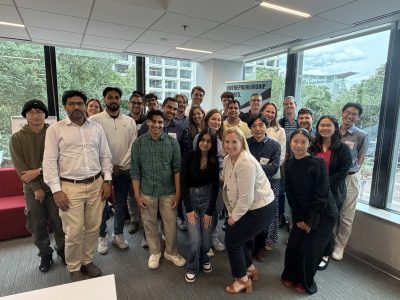
The Connecticut Center for Entrepreneurship & Innovation (CCEI) is proud to recognize the May/June 2026 cohort of Accelerate UConn Propelus, UConn's National Science Foundation (NSF) I-Corps program that equips researchers with the tools to evaluate the commercial potential of their innovations. Throughout the four-week program, interdisciplinary teams explored how to transform promising research into solutions that address real-world challenges.
The cohort kicked off with an engaging in-person workshop before continuing through a series of virtual sessions covering key topics such as customer discovery, value proposition development, business model design, intellectual property considerations, and commercialization strategy. A cornerstone of the program was the customer discovery process, during which each team conducted at least 20 interviews with potential customers, stakeholders, and industry experts. These conversations helped participants test assumptions, identify unmet needs, refine their innovations, and better understand the markets they hope to serve. Teams that successfully completed the program also received a $1,500 NSF stipend to support ongoing customer discovery and commercialization activities.
The May/June cohort showcased the strength of UConn's innovation ecosystem, with researchers from diverse disciplines collaborating to advance technologies and solutions with meaningful societal and economic impact. Their curiosity, adaptability, and commitment to evidence-based entrepreneurship exemplify the mission of Accelerate UConn Propelus.
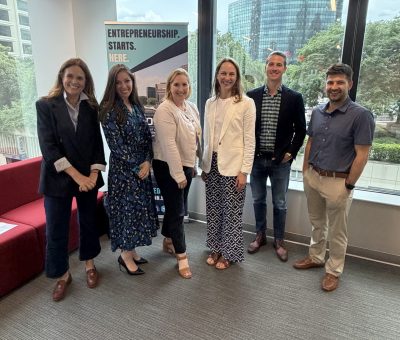
We extend our gratitude to this cohort's instructors — Michelle Cote, Claire Zick, Leland Holcomb, and Scott Alpizar, as well as pod mentors Allison Meyler, Brianna Barrett, and Ryan Gresh.
As part of UConn's participation in the NSF Innovation Corps (I-Corps™) Northeast Hub, Accelerate UConn Propelus connects researchers to a national network dedicated to translating breakthrough discoveries into market-ready innovations. Through customer-focused entrepreneurship training and mentorship, participants gain the skills, resources, and connections needed to accelerate the commercialization of technologies across industries ranging from healthcare and advanced manufacturing to sustainability, climate technology, and beyond.
For questions, please contact Alycia Chrosniak at alycia.chrosniak@uconn.edu.
May/June NSF Accelerate UConn Cohort:
CampReady
Jahanbakhsh Ghasemi, Leila Sharifi
A digital platform designed to make camping more accessible, convenient, and less intimidating for people who want to spend time in nature but lack equipment, experience, confidence, or companions. The platform would help connect new or under-equipped campers with experienced campers, available equipment, and camping-related support services.
CalciFold
Cindy Li, Lixia Yue, Xin Li
Developing peptide inhibitors that selectively target a calcium channel implicated in cardiovascular diseases such as atherosclerosis and aneurysms, enabling localized, non-systemic treatment. The process will potentially advance more precise and personalized therapeutic approaches by improving targeted intervention.
Hoshino Lab
Kazunori Hoshino, Venkatanathan Kidambi, Mitchell Modarelli, You Lyu
Providing a method and materials to treat bone and joint through IoT cameras and microfluidics.
Orchestrated Biosciences
Alex Nesta, Noel Cruz
Building software that lets biomedical researchers analyze complex genomic and clinical data by asking questions in plain English instead of writing code. Our platform uses AI agents that understand both the biology and the analysis tools, so a researcher can ask something like "compare survival outcomes between these two patient groups" and get back real results and charts grounded in their data.
Sonara Labs
Ze'ev Drukker, Liam Power
Building a better ultrasound — a broadband transducer ultrasound combined with real-time multi-frequency signal fusion and physics-informed computational reconstruction. Rather than layering AI on top of already-formed images, the goal is to redesign the acquisition and reconstruction stack so that more usable signal is captured and integrated in real time
UCONN E-Nose
Md Delowar Hossain, Brian Willis
An electronic nose that is capable of detecting chemical scents in real-world environments and can be used to generate chemical fingerprints smelling different volatile organic compounds in the atmosphere. It has potential to detect a wide range of signature chemicals in different sectors including food quality monitoring, precision agriculture, healthcare diagnostics, public safety, and environmental monitoring.
Helio
Pragyan Yadav, Shai Verma
Using rooftop sensors and AI to predict your solar output, catch underperformance or failures early, and help you plan when to use energy so you avoid grid costs and extend battery life.
Plastivore
Sarah Pasqualetti, Kat Milligan-McClellan
An environmental bacteria with the ability to degrade plastic.
SuperSurface
Seok-Woo Lee, Alexander Horvath
A laser-based surface treatment process that improves the hardness and wear resistance of aluminum alloy components in a single step. By rapidly melting and re-solidifying a thin surface layer using a precisely controlled laser, the process traps strengthening elements within the aluminum in a way that conventional manufacturing cannot achieve, resulting in a surface that is 3–4 times harder than untreated aluminum.