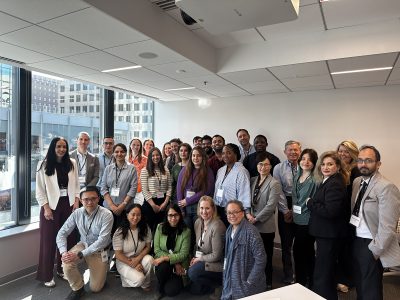
The Connecticut Center for Entrepreneurship and Innovation (CCEI) is excited to spotlight the April 2026 cohort of Accelerate UConn, UConn’s National Science Foundation (NSF) I-Corps program focused on helping researchers evaluate the commercial potential of their innovations. Over four weeks, participating teams immersed themselves in entrepreneurial training designed to bridge the gap between academic research and marketplace application.
The program began with an interactive, in-person session and continued through a series of guided webinars exploring topics including customer discovery, defining a strong value proposition, and assessing product-market alignment. As part of the experience, each team completed at least 20 customer discovery interviews with prospective users, collaborators, and industry professionals. These conversations provided insight into real-world challenges, helping participants validate assumptions, better understand market needs, and explore potential pathways for commercialization. Teams that successfully completed the program also received a $1,500 NSF stipend to support continued research validation and future development efforts.
Each cohort continues to demonstrate an impressive level of innovation, collaboration, and commitment to turning research into impact-driven solutions.
We also extend our appreciation to instructors Michelle Cote, Kim Conti, Mandy Major, Claire Zick, Allison Meyler, Scott Alpizar, and Brianna Barrett for sharing their expertise and mentorship throughout the program.
Through UConn’s involvement in the NSF Innovation Corps (I-Corps™) Northeast Hub, researchers gain access to a broader national ecosystem committed to advancing innovation and entrepreneurship. The hub supports commercialization efforts across a wide range of industries — from biomedical and climate technologies to sustainability and advanced materials — while creating opportunities for innovators from diverse disciplines and institutions to bring breakthrough ideas to life.
Questions about Accelerate UConn Propelus can be directed to Alycia Chrosniak at alycia.chrosniak@uconn.edu.
April Accelerate UConn Cohort:
5MatterLab
Jasna Jankovic, Sara Pedram, Yinyu Wang
A novel design of a fuel cell that has >50% reduced weight and volume, compared to commercial planar fuel cells.
AeroGraphiX
Deep Shikha Srivastava, Douglas Adamson
Graphene-modified HEPA filters for advanced air filtration that can catch viruses.
Colibri Delivers
Matthew Barros, Cody Foust
A cloud-based orchestration layer that utilizes heuristic algorithms and real-time data integration to synchronize fragmented transportation networks. The system architecture includes a dynamic routing engine capable of processing asynchronous inputs from diverse carriers (road, boat, last-mile). It employs automated hand-off protocols to maintain data integrity across multi-modal transitions, specifically designed to handle high-variance environmental data and non-standardized infrastructure common in developing regions.
SEAWELL
Lindsay Smith, William Smith
A non-alcoholic functional carbonated beverage with all natural ingredients.
TamperTrace
Boluwatife Faremi, Anand Dixit
A smart sensor system that fits inside checked luggage and detects unauthorized access in real time. When a bag is tampered with during transit, the system instantly alerts the traveler through a mobile app, providing timestamped evidence of the breach. Unlike passive tracking devices that only locate a bag, TamperTrace detects the act of tampering itself, giving travelers awareness, documentation, and peace of mind from check-in to baggage claim.
OralMap
Behnoosh Hormozi, Ehsan Amini, Thais Fernandes Poleti
An AI-based platform that helps people monitor their oral health at home and decide when to see a dentist.
Hear and Connect
Leila Sharifi, Jahanbakhsh Ghasemi
Improving conference networking outcomes by reducing two common friction points: poor communication in loud halls and lost contact information after the event. The product enables fast pairing between two attendees, clearer conversation through personal earbuds/headphones, and automatic contact exchange with follow-up tools. It can be offered directly to attendees and also as an event add-on for organizers, with an optional microphone kit for premium networking areas.
Ideatech
Salim Mirshahi, Monireh Mirshahi
An enhanced portable blood donor chair that integrates a lightweight, foldable, and ergonomically designed physical platform with an embedded AI application that collects selected patient-specific physiological and demographic data (e.g., vital signs, age, weight, prior donation history, and sensor-based indicators and etc.) to support real-time prediction of key blood test results prior to or during donation. This combined hardware-software solution addresses two major challenges faced by blood banks and mobile collection organizations: the logistical burden of transporting bulky equipment and the inefficiency caused by late-stage donor deferrals due to unfavorable blood test outcomes.
MyoGenex
Carolyn Kaya, Kimberly Griffin, Tolga Kaya
A combinatorial program using RNA technology to correct the mutated gene, and allow the affected protein’s translation to be corrected.
Veritas Dx
Joetta Stewart, Richard Thompson
A non-invasive point-of-care diagnostic tool that detects a specific gastric enzyme in oral fluid, providing clinicians with an objective indicator of reflux activity in patients who cannot self-report symptoms — primarily infants and young children. Current diagnostic options are either invasive, expensive, and require hospitalization, or rely entirely on clinical judgment. PepPOP™ provides an instantaneous result during a routine clinical encounter with no instrumentation required. The commercial opportunity spans pediatric primary care, ENT, gastroenterology, and dental settings, with an initial regulatory pathway targeting professional clinical use.
DepoNeedle Therapeutics
Steven Toro, Ali Tamayol
A handheld medical device to deliver therapeutic biologic agents to damaged soft tissue via a motorized micro needling approach as opposed to applying them to the surface of a wound. The device will deposit a pre-formulated hydro gel containing therapeutic proteins at controlled depths into the tissue, thereby improving the ability of the drug to be retained at the site of injury and improve bio availability at the site of injury where actual healing takes place.
Lavoro AI
Mooyeon Oh-Park, Jean Oh
Exploring how Physical AI can improve safety and care delivery in healthcare and aging settings. It focuses on reducing reliance on costly, labor-intensive supervision models (like one-to-one patient monitoring) by providing continuous, context-aware insights into patient behavior and risk. Rather than replacing clinical staff, the technology operates behind the scenes to enhance situational awareness and support better decision-making.