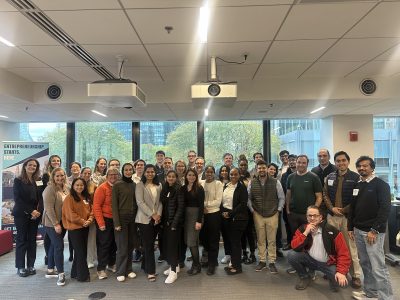
The Connecticut Center for Entrepreneurship and Innovation (CCEI) is excited to recognize the October/November cohort of Accelerate UConn Propelus — the university’s National Science Foundation (NSF) I-Corps program dedicated to helping researchers explore the commercial potential of their innovations. Over the span of four fast-paced weeks, participants immersed themselves in entrepreneurial training designed to move their early-stage ideas closer to real-world impact.
This cohort kicked off with an in-person workshop, followed by three structured webinars focused on customer discovery, value propositions, and market fit. Each team conducted a minimum of 20 customer interviews to test assumptions, uncover unmet needs, and determine whether their innovations could solve meaningful problems outside the lab. Upon completion, teams received a $1,500 NSF stipend to continue validating their technology and pursuing next steps.
We’re inspired by the drive, creativity, and resilience this group has demonstrated. Special thanks go to our Propelus instructors, including Jennifer Mathieu, Jenn Burka, Leland Holcomb, and Claire Zick, whose experience in the NSF innovation ecosystem helped participants refine their approach, challenge their thinking, and build confidence in the commercialization process.
Earlier this year, UConn joined the NSF Innovation Corps (I-Corps™) Northeast Hub, a regional effort designed to transform research into startup ventures that address real societal challenges. Powered by a national NSF network, the Northeast Hub supports commercialization in areas ranging from biomedical innovation and climate solutions to advanced technology, while opening doors for researchers from diverse institutions and disciplines.
October/November Accelerate UConn Propelus
AI Companions Design
Miao Guo, Mohammad Edalati Tabrizi
AI companions designed as mobile app or chatbot that supports the daily well-being of young adults. Specifically, the app design includes such innovative features: 1) supportive conversation (large language model-based, not therapy); 2) mood check-ins and micro-EMAS (micro ecological momentary assessments). Unlike traditional surveys, micro-EMAs are designed to be completed in just a few seconds, usually with 1~3 questions; 3) just-in-time micro-intervention triggered by check-ins or time windows, and 4) goals and habit scaffolding with weekly review.
Whole Athlete Coaching
Jaci VanHeest, Sandy Chafouleas
A digital platform using existing educational technology infrastructure, leveraging proven online learning management systems that can deliver modular, age-specific content with personalized learning paths. The core technical components—video delivery, progress tracking, assessment tools, and certification management—are well-established technologies that can be integrated and customized for our specific coaching education needs. The platform can scale globally through cloud-based infrastructure, and our evidence-based content development approach ensures systematic creation of materials that can be continuously updated and expanded.
Dataerai
Joshua C. Agar, Tim Kuehlhorn, Chirayu Nikunjbhai Patel
A federated, centralized data platform purpose-built for research. It standardizes data into AI-ready formats, and provides searchable metadata ensuring immediate compatibility with advanced analytics and machine learning. It achieves economies of scale, reducing costs while enhancing performance, security, and compliance. Most importantly, it enables the harnessing of collective intelligence, transforming fragmented datasets into a powerful, diverse knowledge base that drives discovery.
Infodemica
Nora Al-Roub, Ethan Hsu, Anand Ranganathan
An AI-powered platform that converts scientific and medical research papers into short, accurate, easy-to-understand educational videos. The platform is designed to help healthcare professionals, researchers, educators, and public health organizations quickly communicate evidence-based information to broader audiences through engaging visual content. By combining natural language processing with automated video generation, Infodemica reduces the time and cost required to translate complex research into digestible formats.
Vestrenx
Antonia Maria Nunez Ancajima, Bruno Fetta
A fintech initiative that helps Latam’s informal vendors transition toward financial inclusion and tax compliance through an intuitive digital platform. The application allows micro-entrepreneurs to record daily sales and expenses, receive personalized financial guidance, and get automated reminders for tax deadlines—all in a simple, educational, and accessible format. The system connects users with banks and microfinance institutions, promoting access to savings accounts, loans, and digital payment tools.
WashDog
Steven Kelly, Scott Stewart
A detection device that prevents valuables from being lost or damaged. While first designed for home laundry use, the same approach can improve safety in aviation by ensuring tools aren’t left behind, and in healthcare by helping track surgical instruments. The concept offers value across consumer and professional settings where preventing loss and error is essential.
Thermophile
Mihai Duduta, Charles DiLorenzo, Denise Maria de Andrade
A spintronic based sensor for detecting hot spots during chip manufacturing. The material can detect failures at nW of power, allowing for faster, more efficient chip manufacturing.
Conan Defense Solutions
Robinson Sander, Farsana Daud
A single-use, non-lethal device to neutralize hostile drones and small unmanned vehicles at close range without radio signals or kinetic weapons. Compact and launcher-compatible, it offers security teams and law enforcement a cost-effective, scalable “last-layer” defense solution for urban and sensitive environments.
ARENA Robotics
Eduardo Raz Guzman, Logan Trexler, Owen Miller
A highly configurable data logger, purpose built for robotics. The original design focused on providing easily interpretable data in extreme environments like combat robotics. The device requires minimal setup enabling customers to build systems faster. This versatility allows the device to integrate easily with a wide range of robotic platforms, making it suitable for research, education, industrial diagnostics, and beyond.
BioTrace
Azeem Sarwar, Yu Lei
A biosensor platform to detect acetate in wastewater streams using microalgae. The system explores two main detection strategies: (1) an optical approach using dissolved oxygen (DO) probes with immobilized algae that respond to acetate presence, and (2) an electrochemical method that leverages biological activity for signal generation. The goal is to create a low-cost, portable solution for real-time monitoring of organic pollutants, supporting environmental compliance and sustainable water management.
Azyme
Maham Liaqat, Riddhi Viradiya
An artificial enzyme catalyst that merges protein scaffolds with cofactors to drive highly selective and efficient chemical transformations. Operating under mild, aqueous conditions, it reduces energy use and waste while enabling enantioselective synthesis critical for pharmaceuticals and fine chemicals. The commercial vision is to provide scalable, customizable catalyst platforms that replace conventional, less sustainable processes, with opportunities for both IP licensing and direct industrial applications.
Matxh
Gauthami Hanamakonda, Yeshwant Santhanakrishnan Premanand
A mobile app that matches medications by active ingredients, helping users find safe equivalents when their medication is unavailable locally or doesn't exist internationally. Users search by name or photo to identify alternatives, locate nearby pharmacies, and access safety information. The platform addresses a critical gap for 300+ million medication-dependent travelers and everyday consumers seeking generic alternatives, with 15% experiencing health issues from incorrect substitutions. Our freemium model ($4.99/month) targets consumers while B2B partnerships with insurers, pharmacies, and travel companies generate enterprise revenue ($50K-200K/year).
—
Want to learn more about joining a future cohort? Explore upcoming Spring 2026 program dates, info sessions, and eligibility at ccei.uconn.edu/accelerate-uconn, or visit the I-Corps Northeast Hub website at icorpsnortheasthub.org.
For questions about Accelerate UConn, contact Alycia Chrosniak at alycia.chrosniak@uconn.edu.